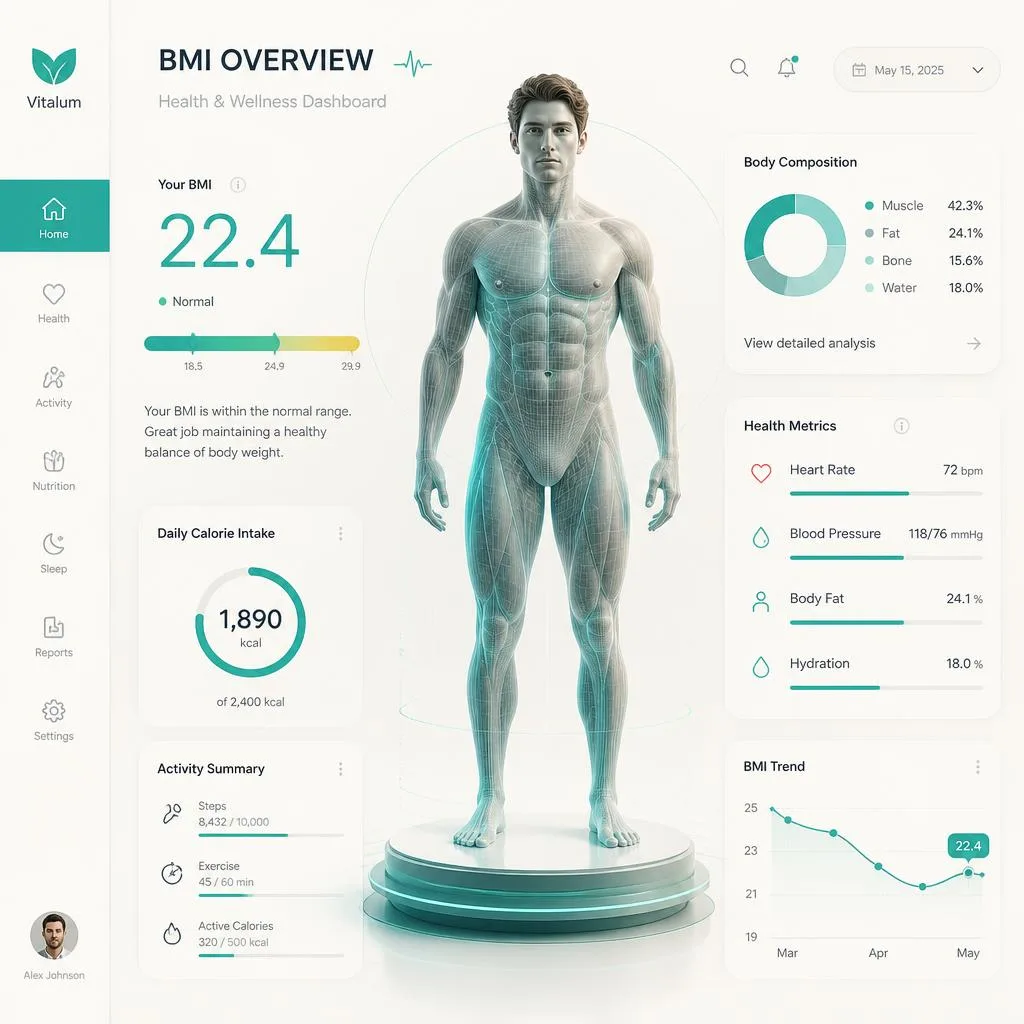
Standard BMI has been the default body composition metric for decades — but it cannot distinguish muscle from fat, ignores fat distribution, and systematically misclassifies specific groups. Metabolic BMI combines BMI with waist-to-height ratio, Body Roundness Index (BRI), and ABSI to produce a more clinically meaningful score. This report quantifies how often the two measures disagree — and what that means for health assessment.
- An estimated 1 in 4 people classified as "normal weight" by BMI show elevated metabolic risk markers when waist-to-height ratio is included
- Athletes and muscular individuals are systematically overclassified by BMI — up to 30% of elite athletes score "overweight" despite low body fat
- BMI underestimates risk in older adults (65+) due to age-related muscle loss — a normal BMI with high visceral fat carries similar risk to clinical obesity
- South and East Asian populations face health risks at BMI thresholds 2–3 points lower than WHO standard cutoffs
- Waist-to-Height Ratio below 0.5 remains the single strongest predictor of cardiometabolic risk across all ethnicities (Ashwell et al., 2012)
Reclassification Rates by Group
Estimated percentage of individuals whose health risk category changes when Metabolic BMI is used instead of standard BMI. Based on published clinical studies.
| Group | BMI Category | Reclassification Rate | Direction |
|---|---|---|---|
| Athletes / muscular individuals | Normal → Overweight | ~30% | BMI overestimates risk |
| Adults 65+ (sarcopenic) | Normal → Higher risk | ~25% | BMI underestimates risk |
| South/East Asian adults | Normal → Elevated risk | ~20% | BMI uses wrong thresholds |
| Women (higher body fat %) | Normal → Elevated risk | ~18% | BMI underestimates risk |
| General population (all adults) | Any → Different category | ~15–20% | Mixed direction |
| Men (higher muscle mass) | Overweight → Normal risk | ~12% | BMI overestimates risk |
| Children & adolescents | N/A — WHO percentiles apply | N/A | Different methodology required |
BMI vs Alternative Metrics
| Metric | Measures | Fat Distribution | Ethnicity Adjusted | Clinical Validation |
|---|---|---|---|---|
| Standard BMI | Weight/height² | No | No | High (legacy) |
| Waist-to-Height (WHtR) | Central adiposity | Yes | Yes | High |
| Body Roundness Index (BRI) | Body shape + visceral fat | Yes | Partial | Moderate |
| ABSI | Abdominal obesity risk | Yes | Yes | Moderate |
| Metabolic BMI (composite) | BMI + WHtR + BRI + ABSI | Yes | Yes | Growing |
Why BMI Misclassifies These Groups
Athletes and Muscular Individuals (~30% reclassification)
The fundamental flaw of BMI for physically active people is its inability to distinguish lean muscle mass from adipose tissue. A competitive cyclist or rugby player with 10% body fat and substantial muscle development will often record a BMI of 25–28 — technically "overweight" by WHO standards. Romero-Corral et al. (2008) found that BMI misclassified 30% of subjects in a large cohort study when compared against dual-energy X-ray absorptiometry (DXA) body fat measurements. For elite athletes, the misclassification rate is even higher. Waist-to-height ratio addresses this directly: a lean, muscular individual typically maintains a WHtR well below 0.5 despite an elevated BMI. This single measurement is sufficient to override an "overweight" BMI classification in the vast majority of athletic cases. The practical implication: any fitness professional, physician, or insurer using BMI alone to assess athletic clients is working with systematically biased data.
Older Adults (65+) and Sarcopenic Obesity (~25% reclassification)
Ageing produces a predictable and clinically significant shift in body composition: muscle mass declines (sarcopenia) while visceral fat accumulates, even when total body weight and therefore BMI remain stable. This creates the "normal-weight obese" phenotype — an individual with a BMI of 22–25 who nonetheless carries dangerous levels of visceral adiposity. Research consistently shows that normal-weight older adults with high waist circumference face cardiovascular and metabolic risk comparable to clinically obese younger adults. ABSI is particularly effective in this age group because it explicitly models the relationship between waist circumference and mortality risk, which strengthens with age. For adults over 65, a Metabolic BMI assessment that incorporates WHtR will reclassify approximately 1 in 4 "normal weight" individuals into a higher-risk category — a clinically actionable finding that standard BMI screening completely misses.
South and East Asian Populations (~20% reclassification)
The WHO standard BMI cutoffs — overweight ≥25, obese ≥30 — were developed primarily from European population data. For South and East Asian populations, these thresholds are systematically too high: clinical metabolic risk (type 2 diabetes, hypertension, dyslipidaemia) begins to increase significantly at BMI 23, and obesity-level risk occurs at BMI 27.5. The WHO itself acknowledged this in a 2004 Lancet publication recommending adjusted action points for Asian populations. A South Asian individual with a BMI of 24.5 is classified as "normal weight" by standard criteria but is at meaningful metabolic risk. Waist-to-height ratio removes this systematic bias entirely: because WHtR 0.5 is the universal threshold across ethnicities, it accurately identifies risk regardless of the population-level BMI calibration problem. In practice, metabolic BMI reclassifies approximately 20% of South and East Asian adults who would otherwise receive false reassurance from a standard BMI reading.
Women vs Men: The Sex Difference in Body Composition
At any given BMI, women typically have a higher percentage of body fat than men of the same age — a difference of approximately 10 percentage points. This is biologically normal and reflects hormonal differences in fat storage patterns. However, it means that BMI systematically underestimates metabolic risk in women: a woman with a BMI of 24 may have 30–35% body fat, which carries different health implications than the 20–25% body fat of a man with the same BMI. Conversely, men accumulate more visceral fat than women at equivalent body fat percentages, meaning their cardiometabolic risk is concentrated in the abdominal region — precisely what WHtR and ABSI capture. Metabolic BMI reclassifies approximately 18% of women upward (higher risk than BMI suggests) and 12% of men downward (lower risk than BMI suggests). Both adjustments are clinically meaningful for personalised health assessment.
Data & Methodology
Reclassification rates in this report are based on published clinical literature. The key primary sources are: Romero-Corral et al. (2008) for general population BMI misclassification; Ashwell et al. (2012) for WHtR validation across 31 studies; WHO (2004) for Asian population threshold adjustments.
The Metabolic BMI composite score as implemented in the Calcuja Metabolic BMI Calculator uses the following weighted combination: standard BMI (40%), waist-to-height ratio (30%), BRI score (20%), ABSI score (10%). This weighting reflects both the clinical evidence base and the practical availability of measurements for self-assessment.
Limitation: Reclassification rates are population-level estimates derived from study aggregates. Individual variation is high — your personal reclassification likelihood depends on your specific body composition, age, sex, and ethnicity. Use the Metabolic BMI Calculator for an individual assessment.
// Sources & References
- Romero-Corral, A. et al. (2008). Accuracy of body mass index in diagnosing obesity in the adult general population. International Journal of Obesity, 32(6), 959–966.
- Ashwell, M., Gunn, P., & Gibson, S. (2012). Waist-to-height ratio is a better screening tool than waist circumference and BMI for adult cardiometabolic risk factors: systematic review and meta-analysis. Obesity Reviews, 13(3), 275–286.
- WHO (2004). Appropriate body-mass index for Asian populations and its implications for policy and intervention strategies. The Lancet, 363(9403), 157–163.
- Thomas, D. M. et al. (2013). Why do individuals not lose more weight from an exercise intervention at a defined dose? An energy balance analysis. Obesity Reviews, 13(10), 835–847.
- Nuttall, F. Q. (2015). Body Mass Index: Obesity, BMI, and Health — a critical review. Nutrition Today, 50(3), 117–128.
- Thomas, E. L. et al. (2012). The missing risk: MRI and MRS phenotyping of abdominal adiposity and ectopic fat. Obesity, 20(1), 76–87.
Calcuja Research (2026). BMI vs Metabolic BMI 2026: How Often Does Standard BMI Misclassify People? Calcuja.com. https://calcuja.com/research/metabolic-bmi-reclassification-2026/
Frequently Asked Questions
Related Tools & Calculators
Beyond standard BMI — calculate BRI, ABSI, waist-to-height ratio, and a composite Metabolic Risk Score.
Standard BMI with context — normal ranges, health implications, and links to deeper analysis.
Project your lifespan and healthspan based on lifestyle factors, metabolic health, and longevity research.
Calculate your personal carbon footprint across diet, transport, home energy, and lifestyle factors.
For informational purposes only — not medical advice. Consult a qualified healthcare professional for personal health assessment. Full terms