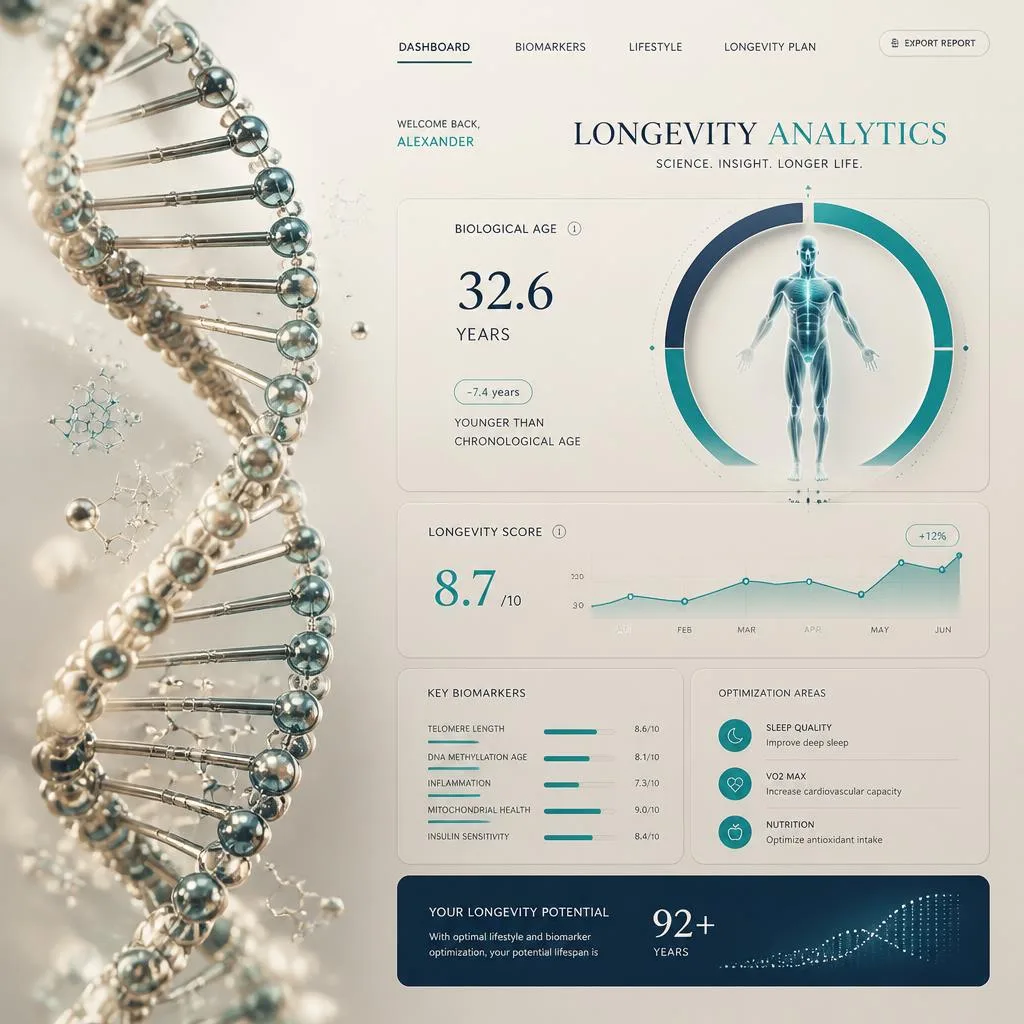
Quantify your projected healthspan in years. Identify your personal longevity bottlenecks based on genetics, lifestyle, and biomarkers.
Calculate your Biological Age Delta. Discover how effectively your interventions lower your biological age versus your chronological age.
Track your Longevity Score daily with sleep, exercise, diet, and stress inputs. Get science-based recommendations for health optimisers.
How much does your peptide & biohacking protocol actually cost per month & per year?
Genetics
Share of longevity variation explained by genetics. Less than most people assume.
Smoking impact
Estimated reduction in lifespan from chronic smoking
Mortality reduction
Risk reduction from moving 'low' to 'above average' cardiorespiratory fitness
Morbidity gap
Average years of poor health at end of life in Western countries
Genetics Is Only 25-30%
Genetics account for approximately 25-30% of longevity variation according to twin studies — less than most people assume. Lifestyle factors dominate, especially when maintained across decades. What gets measured, gets managed. Our tools help you track the 70% that's within your control.
Why Longevity Calculators?
Modern longevity science has advanced beyond simple lifespan estimates. Biological age — how old your cells actually are — can differ from your chronological age by 10–20 years depending on your habits. What gets measured, gets managed.
Our tools are based on peer-reviewed research from Bryan Johnson's Blueprint protocol, the Hallmarks of Aging framework, and validated biomarker studies including the GrimAge and DunedinPACE epigenetic clocks.
Evidence-Based & Privacy-First
Based on validated longevity science
Inputs and weights are derived from published studies on VO₂ max, epigenetic clocks, sleep research, and dietary biomarker data.
No data stored — runs in your browser
All calculations happen client-side. Nothing is transmitted or stored. Your health data stays private.
Actionable, personalised recommendations
Results include specific, ranked recommendations based on your inputs — not generic advice.
Frequently Asked Questions
Related Health & Personal Tools
Body mass index with waist-to-height ratio and ideal weight.
Measure your environmental health impact.
Emergency preparedness budget calculator.
For the researchers among us.
AI existential risk probability estimator.
Compare your salary to billionaires worldwide.