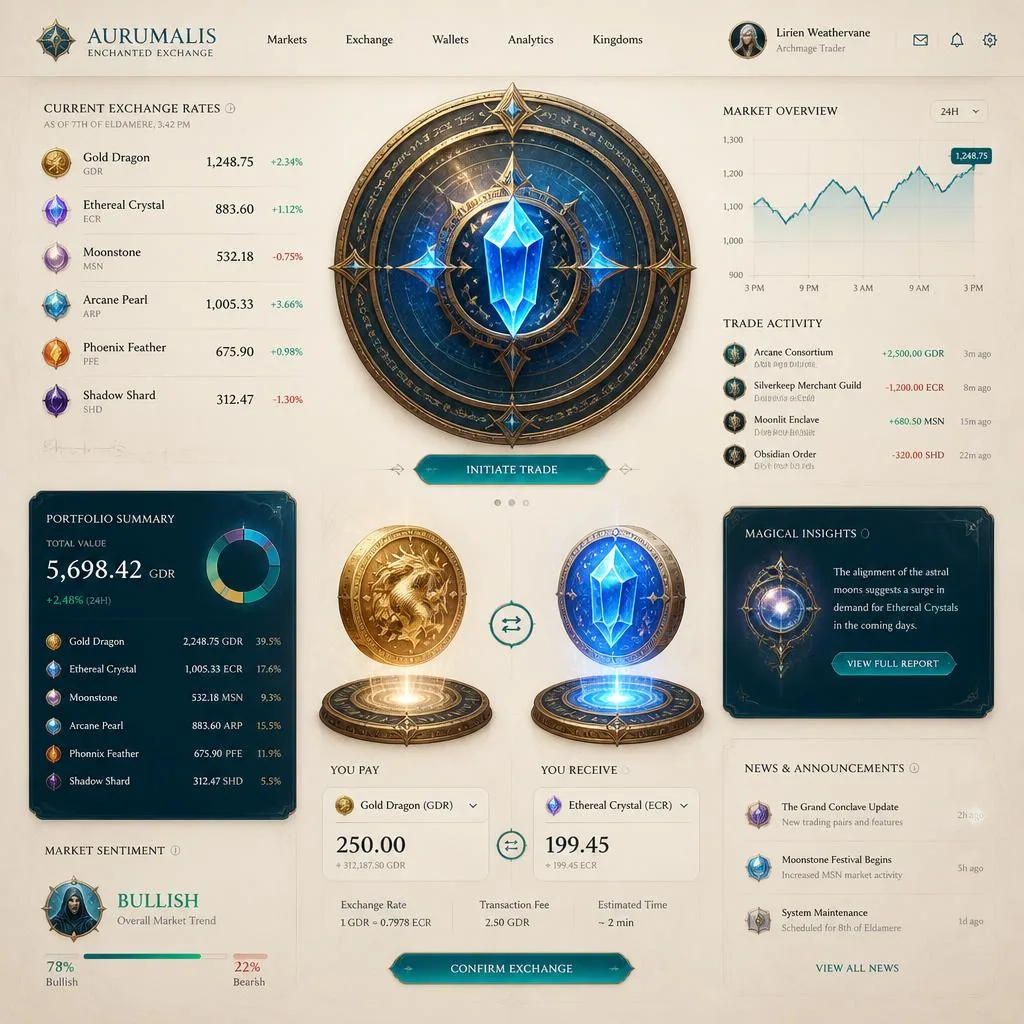
Your Money
Harry Potter, Westeros & Azeroth — How These Rates Actually Work
Three of the most-searched fantasy currencies deserve more than a single number. Each uses a different kind of evidence — an author-stated anchor, a lore-based estimate range, and an official token market — so each gets its own model below.
Harry Potter — Galleons, Sickles & Knuts
Canonical denominations: 1 Galleon = 17 Sickles = 493 Knuts. J.K. Rowling put one Galleon at roughly £5 (≈ $6.35 at reference FX). This is an author-provided approximation, not a market exchange rate.
Westeros — Gold Dragons, Silver Stags & Copper Pennies
No official exchange rate exists. Purchasing-power estimates put one Gold Dragon at roughly $100–$300; the calculator uses the $200 midpoint. Semi-canonical source material gives 1 Gold Dragon = 210 Silver Stags = 11,760 Copper Pennies.
World of Warcraft — Purchasing Power vs. Token Market
WoW gold has two legitimate but wildly different "exchange rates": NPC purchasing power (what gold buys inside the game, ≈ $0.18/gold) and the official WoW Token market (a $20 token trading for roughly 200,000–350,000 gold on US retail — a market snapshot that fluctuates daily and by region).
Game of Thrones
1 USD → 0.005 Gold Dragons (est. $100–300 per dragon)
Harry Potter
1 USD → 0.1575 Galleons (Rowling's ~£5 anchor)
Star Wars
1 USD → 1.45 Galactic Credits (Republic standard)
The Witcher
1 USD → 5 Orens (Northern Kingdoms currency)
Dune
1 USD → 0.01 Solari (spice-backed Imperium currency)
Lord of the Rings
1 USD → 0.5 Gold Coins (Gondor standard)
Star Trek
1 USD → 0.5 Federation Credits (post-scarcity economy)
Skyrim
1 USD → 1.1 Septims (Imperial currency of Tamriel)
Zelda
1 USD → 0.85 Rupees (Hyrule currency, found in pots)
Fallout
1 USD → 2.5 Bottle Caps (Wasteland currency)
Cyberpunk 2077
1 USD → 1 Eurodollar (Night City street currency)
World of Warcraft
1 USD → 5.5 Gold (NPC purchasing power — Token market differs)
Elden Ring
1 USD → 0.15 Runes (Lands Between currency & XP)
Baldur's Gate 3
1 USD → 1 Gold Piece (Forgotten Realms standard)
Understanding Fantasy Currency Conversion
Fictional currencies in books, movies, and games follow internal economic logic rather than real-world exchange rates. Authors and creators establish value through in-universe purchasing power: what a gold dragon can buy in Westeros, what a galactic credit purchases in the Star Wars universe. This calculator uses calibrated rates based on canonical sources and fan analysis to provide meaningful conversions.
Key factors in fictional currency valuation: Scarcity (gold dragons are rare), purchasing power parity (what can 1 credit buy?), narrative consistency (does the rate make sense in-story?), and economic scale (is this a galactic or local economy?). These rates are estimates for entertainment and comparison purposes.
Methodology note: This calculator uses calibrated entertainment estimates across a broad set of universes. Our Fantasy Currency Index 2026 research uses a different Bread Index methodology anchored to real-world and in-game bread prices, so rates for overlapping universes may differ between the two.
What Can You Buy?
$1,000 USD = 5 Gold Dragons (GoT)
At an estimated $200 per dragon: roughly a common sword (2 dragons) and several good inn nights. A knight's ransom (a canonical 300 dragons) would cost about $60,000.
$1,000 USD ≈ 157 Galleons (Harry Potter)
Based on Rowling's ~£5-per-Galleon anchor: a wand (7 galleons, canonical price), textbooks, and plenty of butterbeer (~2 Sickles each).
$1,000 USD = 1,450 Galactic Credits (Star Wars)
A used starship maintenance (~500 credits), blaster pistol (~750 credits), or supplies for a small crew.
$1,000 USD = 5,000 Orens (The Witcher)
Witcher contract payment (~500-1,000 orens), sword repair (~200 orens), or alchemy ingredients.
$1,000 USD = 1,100 Septims (Skyrim)
A horse (1,000 septims), iron sword (25 septims), or a house in Whiterun (5,000 septims — save up more!).
$1,000 USD = 2,500 Bottle Caps (Fallout)
A 10mm pistol (250 caps), stimpak (25 caps), or power armor frame (2,000 caps — almost there!).
$1,000 USD = 1,000 Eurodollars (Cyberpunk 2077)
A handgun (350 eddies), cyberarm implant (5,000 eddies — need more!), or ripperdoc visit (500 eddies).
$1,000 USD = 5,500 Gold (WoW, NPC purchasing power)
An epic mount (5,000 gold) or a transmog token (50 gold). Note: the official WoW Token market values gold far lower — see the featured module above.
$1,000 USD = 150 Runes (Elden Ring)
A longsword (600 runes — can't afford one!), or a few Smithing Stones. Leveling up costs increase with each level.
$1,000 USD = 1,000 Gold Pieces (BG3)
Plate armor (1,500 GP — almost!), healing potions (50 GP each, 20 of them), or a scroll of Revivify (300 GP).
Fictional Economics Follow Narrative, Not Markets
Fictional currencies follow internal economic logic rather than real-world exchange rates. Authors establish value through in-universe purchasing power: what a gold dragon can buy in Westeros, what a galactic credit purchases in Star Wars. These rates are estimates based on canonical sources and fan analysis — calibrated for meaningful comparison rather than accuracy.
Fantasy Currency Questions
Formula & Calculation Method
Purchasing Power Parity (PPP) Exchange Rate
FX_PPP = Price_Local / Price_Foreign (for identical basket)FX_PPP— PPP-adjusted exchange ratePrice_Local— Local currency cost of standardized basketPrice_Foreign— Foreign currency cost of same basket
Source: OECD PPP methodology (Eurostat-OECD PPP Programme)
Big Mac Index (Economist, 1986)
FX_BigMac = Local_BigMac_Price / US_BigMac_PriceSource: The Economist Big Mac Index (since 1986)
Authoritative Sources & Standards
- OECD: OECD-Eurostat PPP statistics adjust GDP comparisons for cost-of-living differences; widely used for international wealth and welfare comparisons. → OECD
Expert Insights & Research
Market exchange rates can deviate 30–50% from PPP rates for years. China's yuan was estimated 30–40% undervalued (PPP-adjusted) for most of 2000–2015. Currency wars and capital controls are real, recurring policy tools.
Related Tools
For informational purposes only — not financial, medical, or legal advice. Results are estimates; use at your own risk. Full terms