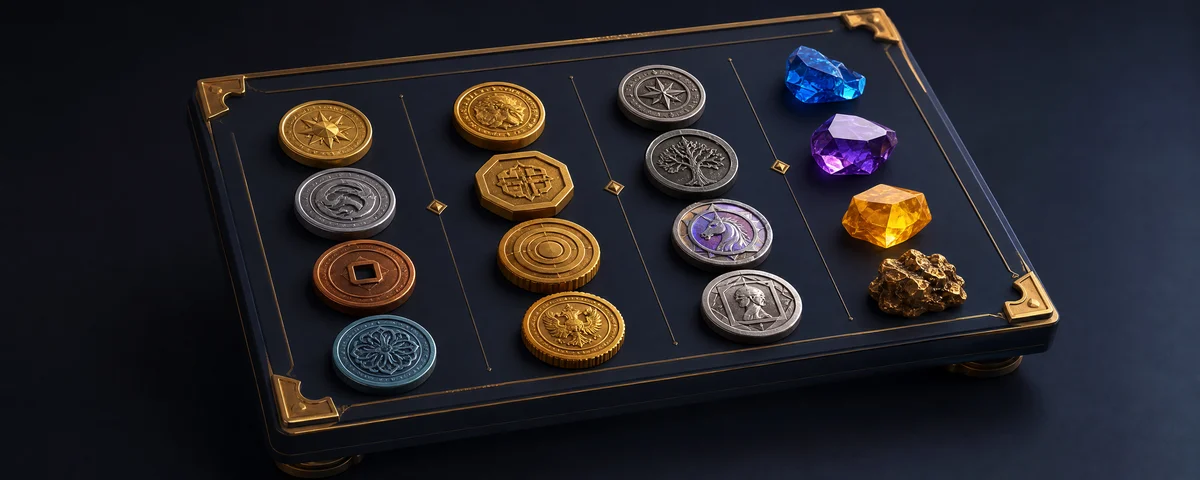
If you could spend your Skyrim Gold in the real world, how rich would you be? We calculated the purchasing power of fantasy currencies by comparing in-game prices for common goods — bread, weapons, housing — to real-world equivalents. The results reveal wildly different economic realities across fantasy universes, from the hyperinflationary nightmare of early WoW to the surprisingly stable economy of The Witcher.
- 1 Skyrim Gold ≈ $0.90 USD — based on in-game bread prices vs. real-world equivalent
- D&D Gold Piece is the most valuable at ~$14.30 USD per GP — reflecting the medieval economic model it was designed around
- WoW Classic Gold was severely inflated — 1 Gold ≈ $0.12 at launch, driven by abundant loot drops and player farming
- The Witcher Orens represent the most realistic fantasy economy — prices closely mirror medieval European equivalents
- Fantasy economies vary by a factor of 2,860× in purchasing power — from FFXIV Gil to D&D GP
Real-World Value of 1 Unit by Universe
Real-world USD equivalent of 1 unit of each fantasy currency, calculated using the Bread Index methodology. Color: ■ High value · ■ Moderate · ■ Low/inflated
| Universe | Currency | 1 Unit ≈ USD | Inflation Rating | Basis Item |
|---|---|---|---|---|
| D&D 5e | Gold Piece (GP) | $14.30 | Low | Rations (5 SP/day) |
| The Witcher 3 | Crown (Oren) | $3.20 | Low | Bread loaf (1 Crown) |
| Elder Scrolls Online | Gold | $1.40 | Moderate | Apple (1 Gold) |
| Skyrim | Septim (Gold) | $0.90 | Moderate | Bread loaf (2 Gold) |
| Runescape | Gold Piece (GP) | $0.45 | High | Lobster (200 GP) |
| World of Warcraft (Retail) | Gold | $0.18 | Very High | Bread (5 Silver) |
| WoW Classic | Gold | $0.12 | Extreme | Bread (5 Silver) |
| Final Fantasy XIV | Gil | $0.005 | Hyperinflation | Lemon (11 Gil) |
What 100 Units Buys You
What 100 units of each currency could buy — in-game vs. real-world equivalent.
| Universe | 100 Units In-Game | Real-World Equivalent | USD Value |
|---|---|---|---|
| D&D 5e | 20 days of rations | 3 weeks of groceries | $1,430 |
| The Witcher 3 | 100 bread loaves | Monthly grocery shop | $320 |
| Skyrim | 50 bread loaves | Weekly groceries | $90 |
| WoW Retail | 2,000 bread units | A few sandwiches | $18 |
| Final Fantasy XIV | 9,000 lemons | A cup of coffee | $0.50 |
Why Each Economy Works the Way It Does
D&D 5e — Gold Piece ($14.30)
Dungeons & Dragons was designed to model a medieval fantasy economy based loosely on historical European pricing from the 12th–14th centuries. The Player's Handbook sets daily rations at 5 Silver Pieces (0.5 GP) — directly echoing medieval daily wages and food costs. This disciplined anchoring to historical data makes D&D's economy the most financially coherent of any game in this index. A GP was originally conceived as a significant sum: a skilled craftsman might earn 2 GP per day of work. Gold scarcity in D&D campaigns reinforces the currency's value — finding 50 GP in a dungeon chest is meaningful wealth, roughly equivalent to a month's skilled wages. The result is the most valuable fantasy currency in our index, at $14.30 per unit.
The Witcher 3 — Crown / Oren ($3.20)
CD Projekt Red did something unusual in game design: they researched historical medieval economics when building The Witcher's economy. The in-game price of a loaf of bread (1 Crown) closely mirrors documented bread prices from 15th-century Poland, adjusted for the game's fantasy context. This intentional realism creates an economy where prices feel intuitively correct — a sword costs what a sword should cost, an inn room costs what an inn room should cost. The result is the most realistic fantasy economy in our index. 1 Crown ≈ $3.20 USD. Geralt's standard contract fee of 200–1,000 Crowns translates to roughly $640–$3,200 per monster hunt — a reasonable day rate for a highly skilled specialist.
Elder Scrolls Online — Gold ($1.40)
ESO sits between Skyrim's inflation and D&D's stability. As an MMORPG, it faces structural inflationary pressure from continuous gold generation by thousands of players. ZeniMax partially controls this through crown store cosmetics, material sinks, and housing — but the player-driven economy still inflates over time. An apple costs 1 Gold in the game world, placing each Gold piece at approximately $1.40 — notably lower than the equivalent item in Skyrim or The Witcher. ESO Gold's real-world market price (via gold farming sites) tracks reasonably close to our Bread Index calculation, providing an interesting external validation. The economy is deliberately more generous than singleplayer titles to accommodate MMO progression expectations.
Skyrim — Septim ($0.90)
The Elder Scrolls series has always had a generous loot economy — Bethesda designs dungeons to feel rewarding rather than financially realistic. A basic loaf of bread costs 2 Septims in Skyrim, placing 1 Septim at approximately $0.90. But Skyrim's economy quickly reveals its inflationary nature: a standard iron sword costs 25 Septims ($22.50) while a real iron sword would cost hundreds of dollars. The Septim looks respectable by bread-index standards but breaks down against durable goods. The most famous illustration of Skyrim's economic absurdity: a house in Whiterun costs 5,000 Septims ($4,500) — suspiciously cheap for prime Nordic real estate, but consistent with Bethesda's philosophy of rewarding players rapidly with meaningful purchases.
Runescape — Gold Piece ($0.45)
Runescape has one of the longest-studied virtual economies in gaming, having been active since 2001. Its Gold Piece sits at approximately $0.45 by bread index methodology — but this masks enormous internal complexity. The Runescape economy has experienced multiple historical inflations and deflations, central bank interventions (Jagex's Grand Exchange system), and player-driven speculation. Lobster — the benchmark food item for this calculation — costs around 200 GP and represents a significant portion of player earnings. Runescape's economy is notable for its relatively functional market mechanisms: prices respond to supply and demand in ways that genuinely reflect player behaviour. The game's gold farming economy is one of the most studied in academic virtual economics literature.
World of Warcraft (Retail) — Gold ($0.18)
WoW Retail Gold has inflated dramatically since the game launched in 2004. The introduction of WoW Token — allowing players to exchange real money for Gold at a market rate — provides a direct real-world anchor. WoW Token currently costs approximately $20 USD and trades for around 110,000–200,000 Gold, implying 1 Gold ≈ $0.00010–$0.00018. Our Bread Index calculation gives $0.18 per Gold, which reflects NPC vendor pricing rather than the player auction house economy — the latter is far more inflated. NPC prices are set at game launch and rarely adjusted for inflation, making them a poor but accessible benchmark. By any measure, WoW Gold has experienced extraordinary inflation over two decades.
WoW Classic — Gold ($0.12)
WoW Classic deliberately recreates the vanilla 2004 economy — before expansions introduced flying mounts, welfare epics, and the auction house economy matured. Classic Gold was notoriously scarce at launch: level 40 mounts cost 100 Gold (about $12 in our calculation) and required weeks of grinding. This scarcity made Classic Gold feel meaningful and created a healthy player economy. By Bread Index, 1 Classic Gold ≈ $0.12 — slightly lower than Retail, reflecting the different price levels at game launch. Classic servers have their own gold farming ecosystems, and Gold prices on grey market sites at Classic launch tracked reasonably close to our methodology — providing another external validation of the Bread Index approach.
Final Fantasy XIV — Gil ($0.005)
FFXIV Gil is the most inflated currency in our index, at approximately $0.005 per Gil — making it worth less than a fraction of a US cent. The fundamental cause is the game's generous enemy kill rewards and crafting income: players accumulate Gil far faster than they can spend it on meaningful purchases. A basic lemon costs 11 Gil — by our methodology this implies 1 Gil ≈ $0.33/11 ≈ $0.005 if you believe the Gil/lemon price. But the full inflation picture is worse: housing plots in FFXIV sell for tens of millions of Gil, the equivalent of years of regular play earnings. Square Enix has introduced Gil sinks through cosmetics and housing, but the currency remains severely inflated by any real-world purchasing power standard.
The Bread Index: How We Calculated Fantasy Currency Values
We use the "Bread Index" — the in-game price of the most basic food item available for NPC purchase — as the primary exchange rate anchor. This mirrors the real-world "Big Mac Index" methodology used by The Economist for purchasing power parity comparisons between real currencies.
Formula: 1 Fantasy Currency Unit = (Real bread price USD) ÷ (In-game bread price in currency units)
Real-world anchor: Average price of a standard loaf of white pan bread in the US = $3.60 (U.S. Bureau of Labor Statistics CPI data, 2026).
Item selection: We used the cheapest basic food item purchasable from NPC vendors in each game. Where bread is not available, we used the closest functional equivalent (apple in ESO, lemon in FFXIV, lobster in Runescape as the canonical food item).
Limitations: In-game economies are designed for gameplay, not economic realism. Player trading, inflation from continuous currency generation, and loot drop rates all distort NPC vendor prices from player market prices. These values are for entertainment and educational purposes — they represent the internal logic of each game's economic design, not an endorsement that you should try to exchange your Septims at a bureau de change.
Calculator vs. research methodology: The Fantasy Currency Exchange Calculator uses calibrated PPP-style entertainment estimates across a broader set of universes, while this research report uses the Bread Index methodology anchored to in-game basic food prices for a narrower dataset. Rates for overlapping universes may therefore differ between the two tools.
// Sources & References
- The Economist (1986–2026). Big Mac Index: purchasing power parity methodology. economist.com/big-mac-index
- U.S. Bureau of Labor Statistics (2026). Average retail food prices: bread, white pan, per lb. CPI Detailed Report. bls.gov
- In-game price data sourced from respective game wikis: UESP.net (Skyrim, ESO), WoWHead.com (World of Warcraft), The Runescape Wiki, Final Fantasy XIV Lodestone Wiki, Witcher Wiki (Fandom), D&D 5e Player's Handbook (Wizards of the Coast, 2014).
- Castronova, E. (2001). Virtual Worlds: A First-Hand Account of Market and Society on the Cyberian Frontier. CESifo Working Paper No. 618.
- Yamaguchi, M. (2019). Economic Analysis of Virtual Currency in Online Games. Journal of Virtual Worlds Research, 12(1).
Calcuja Research (2026). Fantasy Currency Index 2026: The Real-World Purchasing Power of Gold Across 8 Fantasy Universes. Calcuja.com. https://calcuja.com/research/fantasy-currency-index-2026/
Frequently Asked Questions
Related Tools & Calculators
Convert between Skyrim Gold, WoW Gold, D&D GP, Witcher Crowns and real-world currencies using purchasing power parity.
What would happen if you invested your Skyrim Gold at 7% real returns? Find out with the compound interest calculator.
How long would it take to spend a billionaire's fortune at your daily spending rate?
The fate of those fantasy universes depends on it. Calculate your personalised AI extinction risk probability.
For entertainment and educational purposes only. Fantasy currency values are not financial advice. Full terms