Your Role & Financial Position
Job Sector
Your job sector determines AI displacement risk. Data entry, customer service, and accounting face high automation risk (>70%). Trades, nursing, and therapy have low risk (<15%) due to physical dexterity and human interaction requirements.
Seniority Level
Junior roles face higher displacement risk as AI handles entry-level tasks. Senior and executive roles involve strategic judgment, relationship management, and complex decision-making that are harder to automate. Mid-level roles face moderate risk depending on sector.
Risk Assessment & Action Plan
P(doom) Calculator
Global catastrophe probability
Explore →AI Alignment Risk
Technical failure probability
Explore →AI Job Displacement
Your personal career risk
High Risk (70-99%)
Data entry clerks (99%)
Telemarketers (99%)
Bookkeeping / payroll clerks (98%)
Loan officers (98%)
Retail cashiers (97%)
Paralegals (94%)
Financial analysts (junior level) (85%)
Low Risk (0-30%)
Mental health professionals (0.3%)
Surgeons / physicians (0.4%)
Social workers (0.3%)
Elementary school teachers (0.4%)
Skilled trades (plumbers etc.) (0.7%)
Managers & executives (1.5%)
Research scientists (6.2%)
High Protection Factors
- Complex social & emotional intelligence: Very high protection
- Physical dexterity in unpredictable environments: Very high
- Novel problem-solving without precedent: High
- Deep domain expertise + AI tool use: High
- Stakeholder management & leadership: Medium-High
Low Protection Factors (High Risk)
- Repetitive structured data tasks: Very high risk
- Rule-based decision making: Very high risk
- Routine text generation / editing: High risk
- Basic coding / standard code review: High risk
- Standardised analysis and reporting: High risk
How AI Automation Risk Works
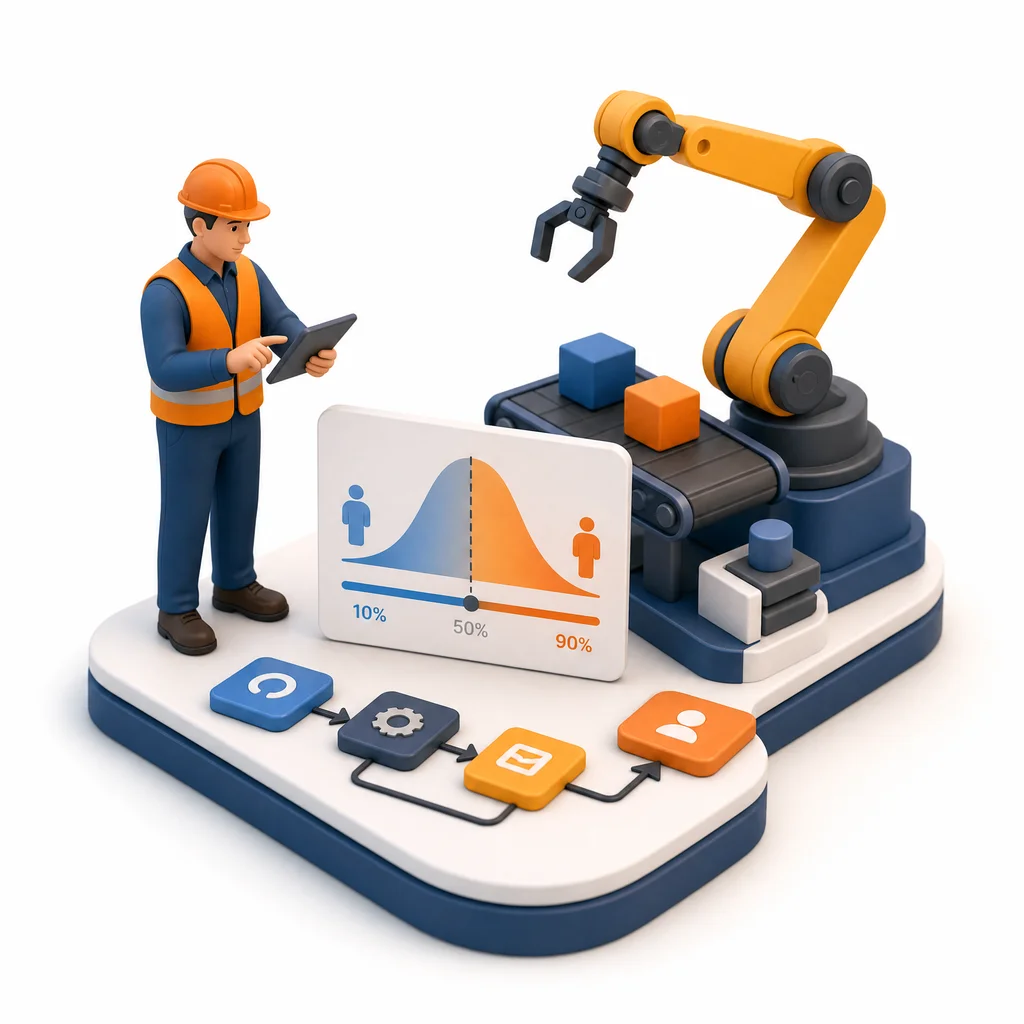
AI job displacement risk isn't binary — it's a spectrum based on task complexity, human interaction requirements, and AI capability. Jobs with repetitive, rule-based tasks (data entry, telemarketing) face 70-99% automation risk. Jobs requiring complex social intelligence, physical dexterity in unpredictable environments, or novel problem-solving face less than 10% risk.
Key insight: Most jobs won't be fully replaced — they'll be transformed. AI will handle routine tasks, while humans focus on higher-value activities. The risk is job transformation, not elimination, for most roles. Adaptation through AI skill development significantly reduces personal risk regardless of occupation.
The AI Skills Advantage
Workers who can use AI tools effectively reduce their displacement risk by 30-50% regardless of occupation. Prompt engineering, AI-assisted analysis, and understanding AI limitations are now critical career skills. The most protected workers combine deep domain expertise with AI tool mastery — becoming "AI-augmented professionals" rather than competing against AI.
AI Job Displacement Questions
Formula & Calculation Method
Job Displacement Risk Score
Risk = (Routine_Cognitive + Routine_Manual) × (1 − Social_IQ_Required) × LLM_Capability_CoverageRoutine_Cognitive— Share of tasks involving structured information processing (0–1)Routine_Manual— Share of tasks involving repetitive physical actions (0–1)Social_IQ_Required— Empathy, persuasion, complex coordination (0–1, protective factor)LLM_Capability_Coverage— Fraction of role's tasks within current LLM/AI capability frontier
Source: Adapted from Eloundou et al., 'GPTs are GPTs', OpenAI/Penn (2023); Frey & Osborne, Oxford (2013)
Authoritative Sources & Standards
- BLS: BLS Occupational Outlook Handbook tracks employment projections through 2032 — incorporates technology adoption assumptions. AI-exposure adjustments not yet integrated; OECD AI Observatory provides supplementary data. → BLS
Expert Insights & Research
Eloundou et al. (2023): ~80% of US workforce has at least 10% of tasks affected by LLMs; 19% have ≥50% of tasks affected. Highest exposure: software developers, paralegals, financial analysts. Lowest: physical-trades, healthcare bedside care.
Historical precedent: ATMs did not eliminate bank tellers — total teller employment rose from 500k (1980) to 600k (2010) as ATMs reduced cost-per-branch and enabled more branches. Job transformation is more common than total displacement.
Related Tools
How much is your job paying you NOT to quit? RSUs, bonuses, retention, pension.
Plan the financial cost of a career break or retraining period.
How long would it take you to earn a billionaire's wealth?
How much does prepping for civilisation collapse actually cost?
For informational purposes only — not financial, medical, or legal advice. Results are estimates; use at your own risk. Full terms