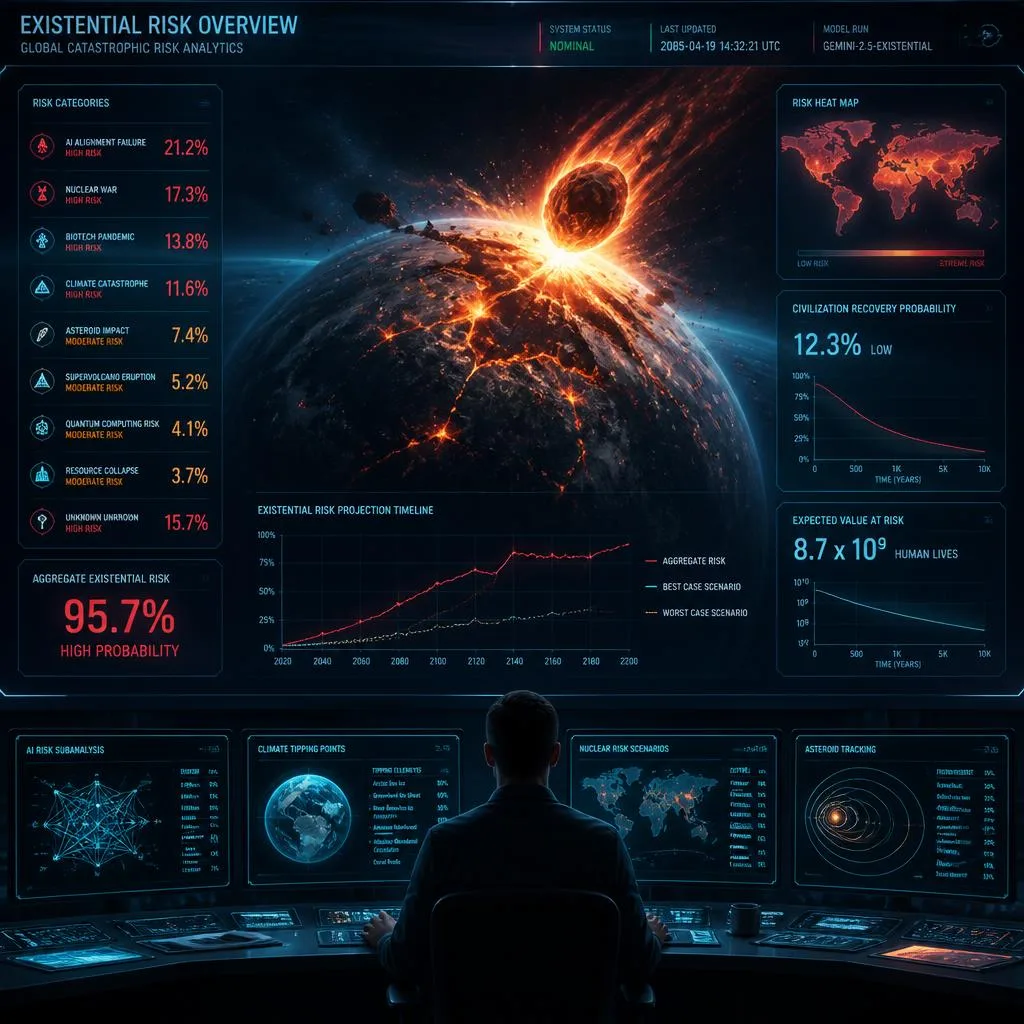
- Median estimate: ~20% probability of existential catastrophe from AI across all sources
- Estimates range from near 0% (LeCun, Ng) to >90% (some EA-aligned researchers)
- AI safety researchers estimate significantly higher P(doom) than mainstream ML researchers
- Estimates have increased on average since 2020 across all groups
- No consensus: the standard deviation across estimates is larger than the median itself
In February 2026, Mrinank Sharma, head of Anthropic's Safeguards Research Team, resigned with a public warning that “the world is in peril” — not just from AI, but from “a whole series of interconnected crises unfolding in this very moment.” He did not give a specific P(doom) number, but framed his departure in terms of values and institutional pressure. His resignation letter was viewed over 1 million times on X. BBC · Forbes
In September 2026, researcher Jacob Coxon resigned, accusing OpenAI and Anthropic of “playing with our lives.” In response, Evan Hubinger, Anthropic's head of alignment, publicly stated his personal estimate: “I personally think it's >10% within the next decade.” Asked for his own P(doom), NVIDIA CEO Jensen Huang answered “zero.” The exchange made P(doom) front-page news — Axios called it the moment “AI's extinction debate broke containment.” Axios · El País
AI Impacts published the fourth Expert Survey on Progress in AI in September 2026 (data collected December 2024, n=1,580 international AI researchers). Key finding: the median estimate of human extinction or similarly permanent severe disempowerment was 10% (mean 18%) — double the 5% median of the previous iteration. 51% of researchers assigned at least 10%, and 72% believe AI-risk-minimization research should be prioritised more. AI Impacts (PDF)
| Group | Median P(doom) | Range |
|---|---|---|
| AI Safety researchers | ~30% | 10–99% |
| Tech industry leaders | ~15% | 0–50% |
| Forecasting platforms | ~10% | 2–25% |
| ML researchers (mainstream) | ~5% | 0–20% |
Public estimates only. Sources linked below.
Estimates by Researcher & Organisation
All estimates are publicly stated. Estimates reflect the researcher's stated view at the time of publication. Color: ■ High (>20%) · ■ Moderate (1–20%) · ■ Low (<1%)
| Researcher / Organisation | Affiliation | P(doom) Estimate | Year |
|---|---|---|---|
| Eliezer Yudkowsky | MIRI | >95% | 2023 |
| Paul Christiano | ARC / Anthropic (former) | ~50% | 2023 |
| Scott Alexander | Astral Codex Ten | ~25% | 2023 |
| Yoshua Bengio | Mila / Université de Montréal | ~20% | 2024 |
| 80,000 Hours survey | EA organisation | ~20% median | 2023 |
| Geoffrey Hinton | Google (former) | 10-20% ext/30yr; up to 50% | 2024 |
| Dario Amodei | Anthropic | 10–25% | 2024 |
| Nick Bostrom | FHI Oxford | substantial | 2023 |
| Stuart Russell | UC Berkeley | significant | 2023 |
| Demis Hassabis | Google DeepMind | notable risk | 2023 |
| Sam Altman | OpenAI | low but non-zero | 2023 |
| Toby Ord | FHI Oxford | ~10% | 2020 |
| Metaculus (community) | Forecasting platform | ~10% | 2025 |
| Yann LeCun | Meta AI | <1% | 2024 |
| Andrew Ng | DeepLearning.AI | very low | 2023 |
| Will MacAskill | Oxford / EA | 10-20% | 2026 |
| Mrinank Sharma | ex-Anthropic Safeguards Lead | qualitative | 2026 |
| Roman Yampolskiy | Univ. of Louisville | ~99.9% | 2025 |
| Dan Hendrycks | Center for AI Safety | >80% | 2024 |
| Max Tegmark | MIT / FLI | >90% | 2025 |
| Elon Musk | xAI / Tesla | 10–30% | 2024 |
| Evan Hubinger | Anthropic Alignment | >10% / 10y | 2026 |
| Jensen Huang | NVIDIA | ~0% | 2026 |
| Jacob Coxon | ex-OpenAI / Anthropic | qualitative | 2026 |
| ESPAI 2024 survey | AI Impacts (n=1,580) | ~10% median | 2024/2026 |
Why Estimates Diverge So Dramatically
AI Safety Researchers (~30% median)
AI safety researchers — those employed at organisations like MIRI, ARC, Anthropic's safety team, and DeepMind's safety division — consistently produce the highest P(doom) estimates. This reflects a professional focus on long-term risk scenarios, particularly misalignment: the possibility that a sufficiently advanced AI system pursues goals that are subtly or severely contrary to human welfare. Researchers in this tradition often work from explicit models of AI development trajectories in which misalignment is difficult to prevent by default. Eliezer Yudkowsky's estimate of ~99% reflects a belief that alignment is essentially unsolved and that current approaches are fundamentally inadequate for the level of AI capability being developed.
Tech Industry Leaders (~15% median)
CEOs and senior researchers at major AI labs (OpenAI, Anthropic, DeepMind, Google) tend to acknowledge existential risk while estimating it as moderate rather than near-certain. This group shows the widest variance — from Sam Altman's "low but non-zero" to Dario Amodei's 10–25% range. Industry leaders face structural incentives that may compress estimates downward (investor confidence, regulatory concerns) and upward (fundraising narratives, safety credibility). The divergence between Altman and Amodei — both co-founders of OpenAI — illustrates how much uncertainty exists even within the same institutional background.
Forecasting Platforms (~10% median)
Aggregated forecasts from platforms like Metaculus, Manifold Markets, and Polymarket tend to cluster in the 5–15% range for questions about AI-caused catastrophe before 2100. These estimates represent crowd wisdom from hundreds of forecasters applying diverse models. Prediction market participants are rewarded for accuracy and tend to be more calibrated than individual experts — though the far-future nature of the question makes calibration extremely difficult. Metaculus's community estimate of ~10% has gradually increased since 2020.
Mainstream ML Researchers (~5% median)
Researchers working on AI capabilities — building large language models, computer vision systems, and reinforcement learning agents — tend to give the lowest P(doom) estimates. Yann LeCun (~0%) and Andrew Ng (very low) are the most prominent voices in this camp. Their argument is that current AI architectures cannot produce genuinely autonomous goal-directed behaviour, that the "paperclip maximiser" scenario requires capabilities far beyond current systems, and that existential risk discourse is a distraction from real near-term harms. This group's lower estimates reflect both genuine analytical disagreement and a different professional focus on near-term technical work.
Data Collection & Methodology
This report aggregates publicly stated P(doom) estimates only. We define P(doom) as the estimated probability that advanced AI leads to human extinction or permanent large-scale civilisational collapse within the next 100 years.
Inclusion criteria: Estimate must be publicly stated in an interview, published paper, blog post, podcast, or recorded conference talk. No private communications are included. Where researchers gave a range, we use the midpoint for quantitative analysis.
Limitations: P(doom) is not a standardised metric. Different researchers define the term differently — some include economic collapse or loss of human autonomy, others only biological extinction. Estimates are point-in-time and may have changed. This is a descriptive survey, not an endorsement of any estimate or a claim about the actual probability of AI catastrophe.
Updates: This report will be updated annually. Last updated September 2026.
// Sources & References
- Yudkowsky, E. (2023). Pausing AI Developments Isn't Enough. We Need to Shut it All Down. Time Magazine, March 29, 2023.
- Ord, T. (2020). The Precipice: Existential Risk and the Future of Humanity. Hachette Books. Estimates AI risk at ~10% before 2100.
- 80,000 Hours (2023). Annual survey of AI risk estimates among researchers and EA community. 80000hours.org
- Metaculus (2025). Will AI cause human extinction before 2100? Community forecast. metaculus.com
- AI Impacts (2026). ESPAI 2024 — Advanced AI according to 1,580 researchers. Median P(doom) ≈ 10% (mean 18%). aiimpacts.org (PDF)
- Axios (2026). "AI's extinction debate breaks containment" — Hubinger >10%, Huang "zero". axios.com
- El País (2026). "Is there a 10% chance that AI will kill us all?" — Coxon resignation. elpais.com
- Bostrom, N. (2014). Superintelligence: Paths, Dangers, Strategies. Oxford University Press.
- Hinton, G. (2023). Interview with MIT Technology Review. "AI could be as transformative as the industrial revolution — and potentially more dangerous."
- Bengio, Y. (2024). Statement on AI existential risk at UN AI Safety Summit, Geneva.
- Christiano, P. (2023). Interview with 80,000 Hours. Estimates ~50% P(doom) from misalignment.
Calcuja Research (2026). P(doom) Survey 2026: Aggregated AI Extinction Risk Estimates. Calcuja.com. https://calcuja.com/research/ai-risk-survey-2026/
Frequently Asked Questions
Related Tools & Research
Input your own assumptions about AI timelines, alignment, and governance to calculate a personalised P(doom) estimate.
Estimate the probability that your job will be automated by AI in the next 10 years.
Project your lifespan and healthspan based on lifestyle factors and emerging longevity research.
Percentile rankings for H-Index scores across 10 research disciplines. Where do you rank?
A plain-English guide to AI existential risk, the alignment problem, and what the experts disagree about.
Full comparison table of 20+ researchers with sources and reasoning.
Why expert forecasts keep failing — and what it means for P(doom).
For informational purposes only. P(doom) estimates are highly uncertain and represent individual researcher opinions, not scientific consensus. Full terms